
Best Islamic Knowledge Books for History, Science, Culture & Civilization | Educational Resources for All Readers
Best Islamic Knowledge Books
Readers, educators, and institutions searching for the best Islamic knowledge books often start with one question: Where can I find well-researched, non-fiction titles that explain history, science, and civilization accurately, without bias, without oversimplification, and without being limited to a children’s shelf?
This guide answers that question directly. It is built for anyone sourcing Islamic civilization books, Islamic heritage books, and Islamic world history titles for a classroom, a library, a collection, a bookstore shelf, or a personal reading list. Every book listed here is a factual, educational resource, not a religious instruction manual, not a devotional text, and not written exclusively for children. These are reference-quality books suitable for students, general readers, researchers, and institutional collections alike.
Why This List Matters
The global interest in Islamic history and its contributions to science, medicine, architecture, and governance has grown steadily among schools, universities, and public libraries. Yet many buyers struggle to find reliable, age-inclusive, and non-partisan resources. That gap creates real challenges for:
- Publishers and distributors seeking accurate backlist and frontlist titles to represent world history categories
- Bookstores that need well-reviewed, broadly appealing non-fiction for their world history or reference sections
- Schools building curriculum-support material for world history, STEM history, or cultural studies
- Libraries expanding multicultural and reference collections for patrons of all backgrounds
This post curates the best Islamic knowledge books currently available, explains what makes each one educationally valuable, and shows how they fit into a well-rounded history and civilization collection.
Best Islamic Knowledge Books: Curated List
1. Influential Muslim Scientists
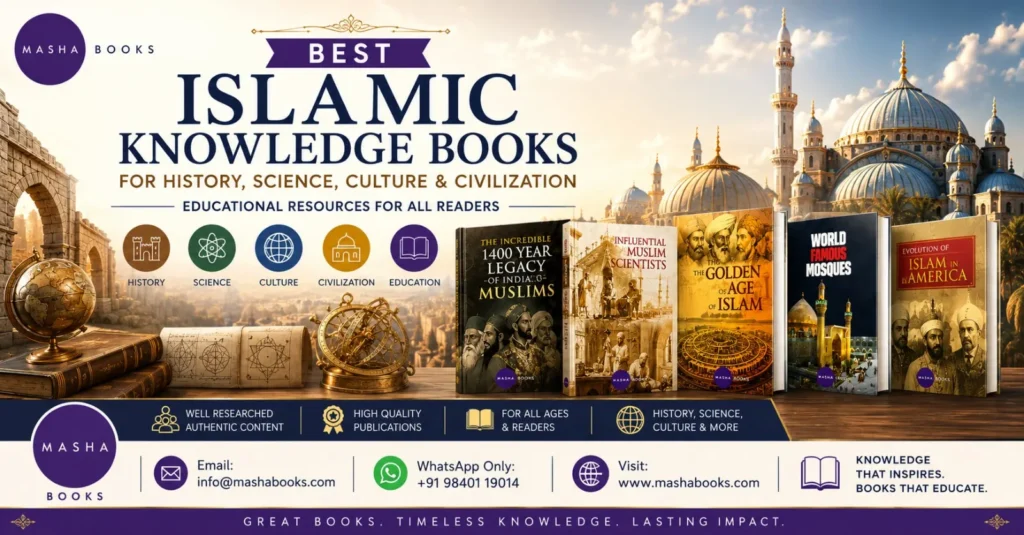
This title documents the scientists, physicians, mathematicians, and inventors whose work shaped fields ranging from optics and astronomy to medicine and engineering. Instead of treating science and Islamic civilization as separate topics, the book shows how discovery and scholarship developed side by side during a major period of intellectual growth. It’s a strong fit for STEM history units, world history electives, and general science-history readers.
Buy on Amazon: Influential Muslim Scientists
2. Great Kings, Rulers and Emperors of the Islamic World
Governance, diplomacy, and leadership are central to understanding any civilization’s history. This book profiles the rulers and dynasties that shaped the political landscape of the Islamic world, their administrative reforms, military strategy, and cultural patronage. It gives readers a grounded, factual account of leadership across centuries, making it a valuable addition to any Islamic world history collection or political history curriculum.
Buy on Amazon: Great Kings, Rulers and Emperors of the Islamic World
3. The Incredible 1400 Year Legacy of India's Muslims
Focused on the Indian subcontinent, this book traces 1,400 years of contribution to architecture, trade, language, art, and administration. It’s especially useful for readers and institutions interested in regional history and the intersection of Islamic and South Asian civilization. This title bridges local and global history, making it a strong choice for comparative world history syllabi.
Buy on Amazon: The Incredible 1400 Year Legacy of India’s Muslims
4. World Famous Mosques
Architecture is one of the most visible and enduring records of any civilization. This book documents mosques recognized globally for their design, engineering, and historical significance, from early structures to modern landmarks. It works equally well as an art-and-architecture reference, a travel-history companion, or a visual resource for design and history students.
Buy on Amazon: World Famous Mosques
5. The Golden Age of Islam
Widely regarded as an entry point into this subject area, this book covers the era when science, medicine, philosophy, and the arts advanced rapidly under successive caliphates. It explains how libraries, translation movements, and scholarly exchange contributed to global knowledge, a period often undercovered in mainstream world history material. This is a top recommendation for readers who want one comprehensive overview before exploring specialized titles.
Buy on Amazon: The Golden Age of Islam
How These Books Fit Into a Wider Islamic Heritage Books Collection
Each title above addresses a different lens: science, leadership, regional history, architecture, and a broad historical era. Together, they form a rounded foundation for anyone building a shelf, unit, or catalog focused on Islamic heritage books. Institutions building a collection should look for this kind of range rather than relying on a single title, since civilization studies benefit from multiple angles: political, scientific, architectural, and regional.
A balanced collection typically includes:
- One general overview title (history and context)
- One science or innovation-focused title
- One leadership or governance-focused title
- One architecture, art, or culture-focused title
- One regional or comparative title
This structure works well for school curriculum mapping, library subject sections, and bookstore category planning.
Who Uses These Books
These titles are designed for a wide readership, not a single demographic. In practice, demand comes from two broad groups:
Institutional buyers (B2B):
- Publishers and distributors sourcing history and reference titles for catalog expansion
- Bookstores stocking world history, non-fiction, or multicultural sections
- Schools building curriculum support for world history, social studies, or STEM history
- Libraries expanding reference and cultural studies collections for diverse patrons
Individual readers (B2C):
- Students researching world history or science history topics
- General non-fiction readers interested in civilization studies
- Parents and educators looking for age-appropriate but substantive material for teens and adults
- Travelers and culture enthusiasts interested in architecture and heritage
How to Choose the Right Titles for Your Collection or Curriculum
If you are sourcing books for an institution, consider these factors:
- Reading level range: Choose titles that work for teens through adults if you need cross-age applicability.
- Subject coverage: Match titles to your existing curriculum gaps (science, governance, architecture, regional history).
- Format needs: Confirm paperback, hardcover, or digital availability for classroom sets or library circulation.
- Bulk and customization options: Ask about bulk pricing, co-branding, or language localization for multi-region distribution.
- Publisher reliability: Work with a publisher experienced in producing accurate, well-reviewed Islamic history content at scale.
About This Resource
This post is part of a broader knowledge series on Islamic history, science, and civilization published to support educators, librarians, and book industry professionals researching this category. It complements our detailed guide, Best Islamic Knowledge Books: Popular Categories and Trends, where you can explore additional categories and current demand trends in this space.
Work With a Publisher That Understands This Category
Masha Books has produced more than 250 titles spanning children’s literature and in-depth knowledge books on Islamic history, science, and culture. Every book is developed with accuracy and cultural sensitivity in mind, and titles are available for:
- Bulk orders for schools and libraries
- Retail distribution for bookstores
- Catalog partnerships for publishers and distributors
- Language customization and regional branding for global markets
If you’re building a curriculum, a store shelf, or a library collection and want reliable, well-researched Islamic knowledge books, we’re ready to help.

As a writer and content strategist at Masha Books, Noufel dedicates his work to one simple goal, making Islamic knowledge accessible to every reader, everywhere. With a deep respect for the tradition and a clear eye on the modern world, he crafts content that bridges the gap between scholarship and everyday life.